

Normal Distribution and Normality
The normal distribution is also known as a Gaussian distribution. It is the most frequently referenced distribution and approximates many natural data tendencies. The normal distribution is a probability distribution of a continuous random variable whose values spread symmetrically around the mean.
A normal distribution can be completely described by using its mean (μ) and variance (σ2) because mean and variance determine the shape of the distribution. When a variable x is normally distributed, we denote:
x ~ N(μ, σ2)
The probability density function of the normal distribution is:

Characteristics of the Normal Distribution
Shape of Normal Distribution
- A normal distribution's probability density function curve is “bell” shaped.
- All normal distributions are symmetric and have bell-shaped density curves with a single peak.
- Location of Normal Distribution.
- The mean, median, and mode will have the same approximate values if a data sample or population is normally distributed.
- The probability density curve of the normal distribution is symmetric around a center value, which is the mean, median, and mode.
- Spread of Normal Distribution.
- The spread or variation of normally distributed data can be described using variance or standard deviation.
- The smaller the variance or standard deviation, the less variability in the data set.
- Empiricle Rule: 68-95-99.7 Rule.
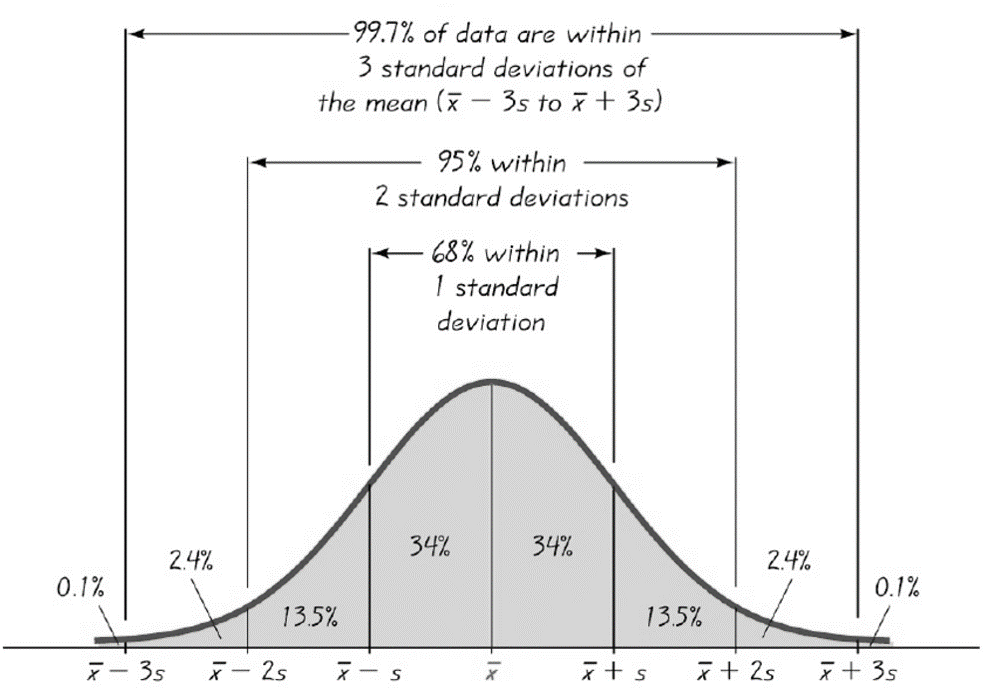
The 68-95-99.7 rule, or the Empirical rule in statistics, states that for a normal distribution.
- About 68% of the data fall within one standard deviation of the mean, that is, between μ-σ and μ+σ.
- About 95% of the data fall within two standard deviations of the mean, that is, between μ-2σ and μ+2σ.
- About 99.7% of the data fall within three standard deviations of the mean, that is, between μ-3σ and μ+3σ.
- The image below depicts this rule:
Normality
Not all distributions with a “bell” shape are normal, so we need to check whether the data are normally distributed. To do so, we should run a normality test. There are different normality tests available.
- Anderson-Darling test
- Shapiro-Wilk test
- Jarque-Bera test
- Normality Testing
Normality tests determine whether the population of interest is normally distributed. As discussed above, several normality tests are available, like the Anderson-Darling test, the Sharpiro-Wilk test, the Jarque-Bera test, and so on. For any of these tests, the null and alternative hypotheses are generally the same:
- Null Hypothesis (H0): The data are normally distributed.
- Alternative Hypothesis (Ha): The data are not normally distributed.
Use Minitab to Run a Normality Test
Steps to run a normality test in Minitab. (Open normality.mtw using Minitab)
- Click Stat -> Basic Statistics ->Normality Test
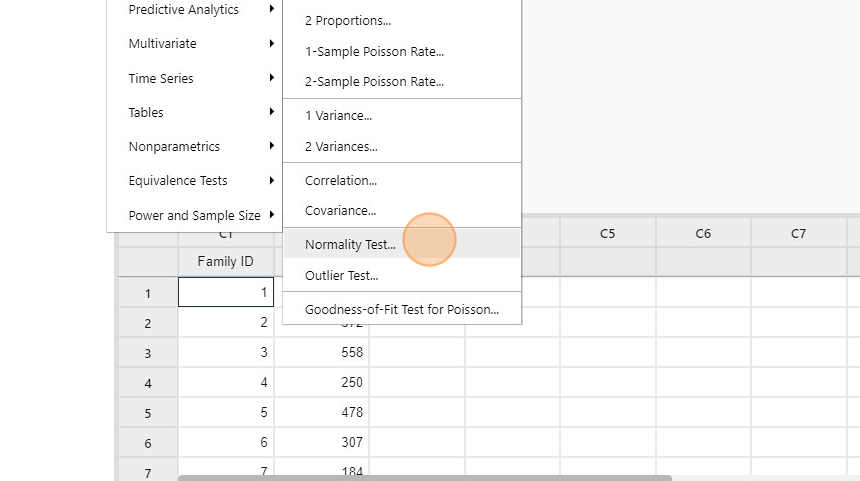
- A new window named “Normality Test” pops up.
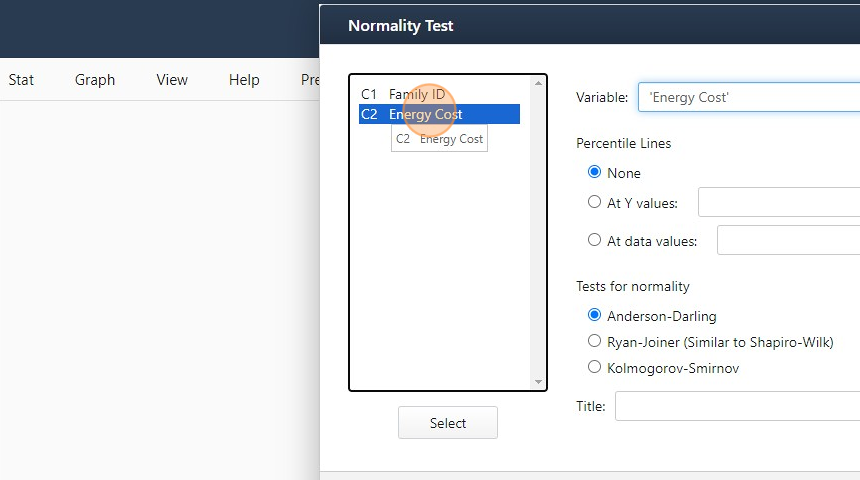
- Double Click “Energy Cost” to Select it as the “Variable”
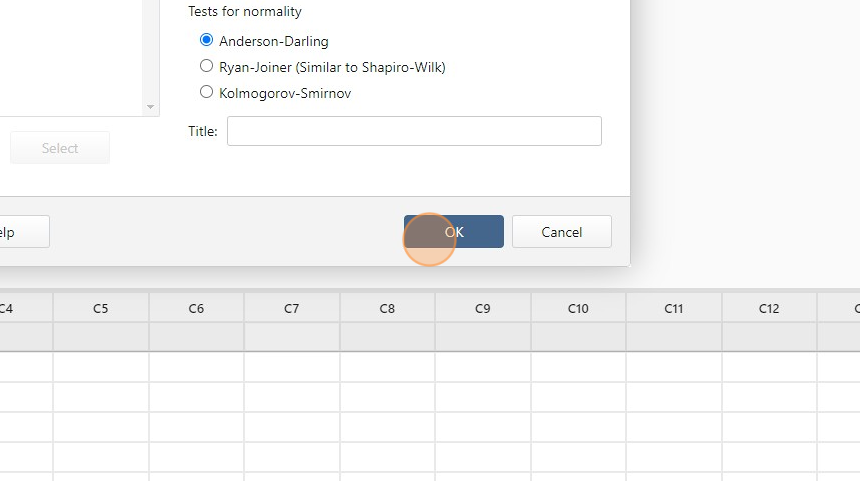
- Click “OK”
- The normality test results appear in the new window
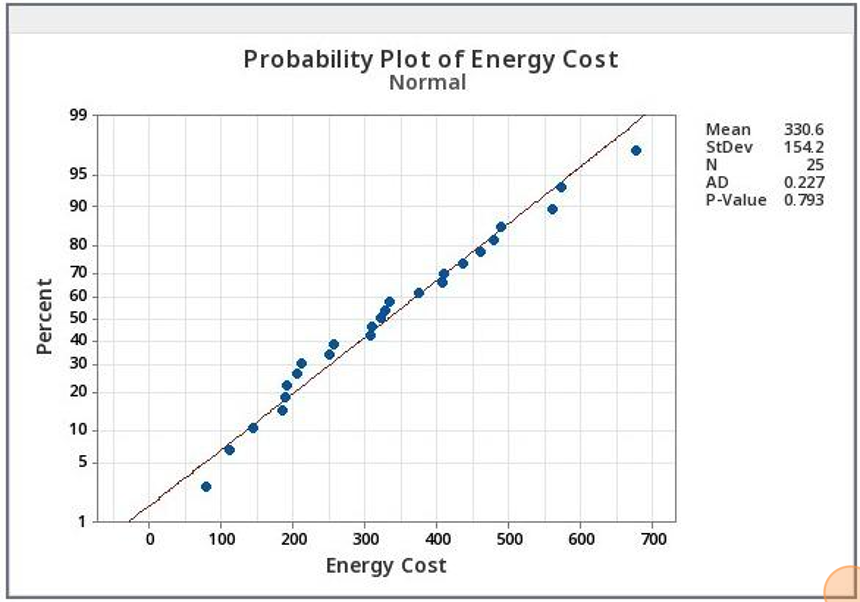
Conclusion: Check the p-value in the graph
Remember our assumptions?
- Null Hypothesis (H0): The data are normally distributed.
- Alternative Hypothesis (Ha): The data are not normally distributed.
- If the p-value is greater than the alpha level (0.05), we fail to reject the null hypothesis and claim that the data are normally distributed.
- If the p-value is less than the alpha level (0.05), we reject the null hypothesis and claim that the data are not normally distributed.
About Lean Sigma Corporation
Lean Sigma Corporation is an independent Six Sigma certification authority responsible for the development, administration, and governance of professional Six Sigma credentials. The organization defines certification frameworks, examination standards, and credentialing systems used to evaluate and recognize Six Sigma competence across professional training environments.
Organizations and instructors delivering Six Sigma training under recognized standards participate in the Authorized Training Partner (ATP) Program.